Innovations in Gear Cutting Tools
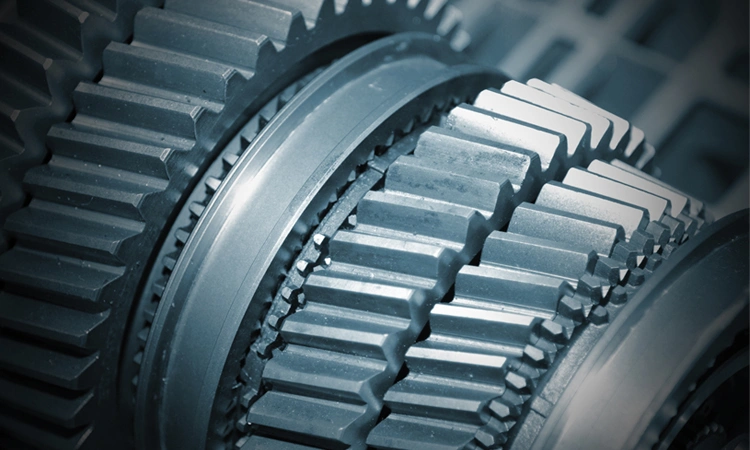
Gears are among the most critical mechanical components used in modern industry. From automobiles and aerospace systems to wind turbines, robotics, machine tools, railways, and industrial automation, gears play a vital role in transmitting power, controlling motion, and ensuring operational efficiency. As industries demand quieter transmissions, higher efficiency, greater load capacity, and longer service life, the precision and quality of gear manufacturing have become more important than ever before. At the center of this transformation lies the evolution of gear cutting tools. Traditional gear manufacturing methods have undergone remarkable technological advancements in recent years, driven by the need for higher productivity, tighter tolerances, superior surface finishes, and the ability to machine increasingly complex materials and gear geometries.
Modern innovations in gear cutting tools are enabling manufacturers to produce gears faster, more accurately, and more economically than ever before. Developments in cutting tool materials, coatings, tool geometries, CNC technology, digital manufacturing, and automation are revolutionizing gear production across multiple industries. As electric vehicles, aerospace systems, renewable energy equipment, and precision industrial machinery continue to evolve, advanced gear cutting technologies are becoming indispensable for next-generation manufacturing.
Growing Importance of Precision Gears
Modern mechanical systems require gears capable of operating under demanding conditions involving:
- High torque loads
- Continuous operation
- Elevated temperatures
- Extreme rotational speeds
- Minimal vibration and noise
- Long service life
In automotive transmissions, even microscopic deviations in gear tooth geometry can affect efficiency, fuel economy, and NVH (Noise, Vibration, and Harshness) performance. Similarly, aerospace and wind energy applications demand gears with exceptional reliability and fatigue resistance.
This growing emphasis on gear quality has accelerated innovation in gear cutting tools and manufacturing processes.
Evolution of Gear Cutting Methods
Gear manufacturing traditionally relied on methods such as:
- Hobbing
- Shaping
- Broaching
- Milling
- Grinding
While these processes remain widely used, modern advancements have significantly improved their productivity and precision.
Today’s gear cutting systems combine advanced tooling with CNC controls, intelligent software, and automated process management to achieve exceptional accuracy and efficiency.
The focus has shifted from merely producing gears to optimizing entire gear manufacturing ecosystems.
![Innovations-in-Gear-Cutting-Bearing-Machine]() High-Performance Gear Hobs
High-Performance Gear Hobs
 High-Performance Gear Hobs
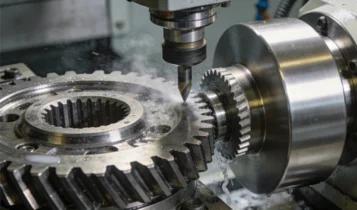
Gear hobbing continues to be one of the most widely used gear cutting processes, especially for external gears.
Modern gear hobs have evolved dramatically through innovations in:
- Tool substrates
- Tooth geometry
- Coatings
- Chip flute design
- Surface treatments
Advanced carbide hobs now allow significantly higher cutting speeds compared to conventional high-speed steel (HSS) tools.
These high-performance hobs provide:
- Increased productivity
- Longer tool life
- Improved surface finish
- Reduced cycle times
- Enhanced dimensional consistency
Specialized hob designs optimized for dry machining and hard gear cutting are further improving process efficiency.
Advancements in Tool Materials
Tool material innovation has played a major role in enhancing gear cutting productivity.
Powder Metallurgy High-Speed Steel
Modern PM-HSS tools offer better wear resistance, toughness, and edge stability compared to conventional HSS tools.Carbide Tools
Solid carbide and indexable carbide gear cutting tools provide exceptional hardness and thermal resistance, enabling high-speed machining of hardened materials.
Cubic Boron Nitride (CBN)
CBN tools are increasingly used in hard finishing applications such as gear grinding and skiving due to their superior wear resistance.
Polycrystalline Diamond (PCD)
PCD tools are ideal for machining non-ferrous gears and lightweight materials used in electric vehicles and aerospace applications.
These advanced materials allow manufacturers to achieve higher cutting parameters while maintaining excellent tool reliability.
Coating Technologies Improve Tool Performance
Modern coating technologies have significantly extended the performance capabilities of gear cutting tools.
Popular advanced coatings include:
- Titanium Nitride (TiN)
- Titanium Aluminum Nitride (TiAlN)
- Aluminum Chromium Nitride (AlCrN)
- Diamond-like Carbon (DLC)
- Nano-composite coatings
These coatings improve: - Wear resistance
- Heat resistance
- Lubricity
- Chip evacuation
- Oxidation resistance
In dry gear cutting operations, coatings become especially important for maintaining tool life under high thermal loads.
Nano-layer coatings are increasingly enabling ultra-high-speed gear machining with reduced friction and enhanced cutting stability.
Gear Skiving Gains Momentum
Power skiving has emerged as one of the most significant innovations in gear manufacturing.
This advanced machining process combines features of hobbing and shaping to efficiently machine internal and external gears on CNC machines.
Power skiving offers several advantages:
- Faster cycle times
- Higher flexibility
- Reduced setup requirements
- Capability to machine complex geometries
- Improved productivity for internal gears
The process is especially valuable in automotive transmission manufacturing, where compact gearbox designs require efficient internal gear production.
Modern skiving tools with optimized geometries and coatings are enabling high-speed production with exceptional precision.
Hard Gear Cutting Technologies
Traditional gear manufacturing often required soft machining followed by heat treatment and grinding.
However, modern hard gear cutting technologies are reducing dependence on secondary finishing processes.
Advanced carbide and CBN tools now enable direct machining of hardened gears through:
- Hard hobbing
- Hard skiving
- Hard shaping
- Advantages include:
- Reduced process steps
- Lower manufacturing costs
- Shorter lead times
- Improved productivity
Hard gear cutting also supports flexible manufacturing environments by minimizing process complexity.
![Innovations-in-Gear-Cutting-Machine]() Innovations in Gear Grinding
Innovations in Gear Grinding
 Innovations in Gear Grinding
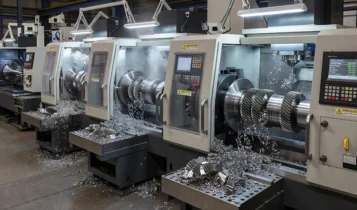
Gear grinding remains essential for ultra-high precision gears used in aerospace, EV drivetrains, robotics, and high-performance industrial applications.
Recent innovations include:
High-Speed Grinding
Modern grinding machines with high-speed spindles significantly reduce cycle times while maintaining superior surface quality.
Advanced Grinding Wheels
CBN grinding wheels provide exceptional wear resistance and profile stability.
Intelligent Dressing Systems
Automated dressing technologies maintain wheel accuracy and optimize grinding consistency.
CNC-Controlled Grinding
Sophisticated CNC systems allow precise control of tooth geometry, lead corrections, and profile modifications.
These innovations enable micron-level precision and superior gear surface finishes.
Digitalization and Smart Gear Manufacturing
Industry 4.0 technologies are transforming gear cutting operations.
Modern gear manufacturing systems integrate:
- Real-time process monitoring
- Tool wear analytics
- AI-driven optimization
- Digital twins
- Predictive maintenance
- Automated inspection systems
- Sensors embedded in machines and tooling monitor:
- Vibration
- Temperature
- Cutting forces
- Spindle load
- Tool condition
This data helps manufacturers optimize cutting conditions, improve consistency, and reduce downtime.
Digital gear manufacturing also enhances traceability and quality assurance.
Multi-Tasking and Hybrid Machines
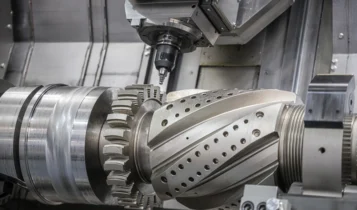
Modern gear production increasingly utilizes multi-tasking machines capable of performing multiple operations in a single setup.
These machines combine:
- Turning
- Milling
- Hobbing
- Skiving
- Grinding
- Inspection
- The advantages include:
- Reduced setup time
- Improved accuracy
- Lower handling costs
- Faster production cycles
Hybrid manufacturing systems integrating additive and subtractive technologies are also emerging for specialized gear applications.
![Innovations-in-Gear-Cutting-Drilling]() Automation Enhances Productivity
Automation Enhances Productivity
 Automation Enhances Productivity
Automation is becoming central to high-volume gear manufacturing.
Automated gear cutting cells now feature:
- Robotic loading and unloading
- Tool changers
- In-process gauging
- Automated deburring
- Intelligent material handling
- Unattended machining and lights-out production are increasingly common in automotive gear manufacturing environments.
- Automation improves:
- Consistency
- Throughput
- Labor efficiency
- Process reliability
As skilled labor shortages continue affecting manufacturing industries, automation adoption is expected to accelerate further.
EV Revolution Driving New Gear Requirements
The rise of electric vehicles is reshaping gear manufacturing requirements.
EV drivetrains demand gears with:
- Extremely low noise
- High efficiency
- Compact designs
- Lightweight construction
- Superior precision
Electric motors operate at much higher rotational speeds than conventional internal combustion engines, making gear quality even more critical.
This is driving demand for advanced gear cutting tools capable of producing ultra-precise tooth profiles and superior surface finishes.
Specialized tooling for lightweight materials and hardened steels is becoming increasingly important in EV production.
Aerospace Applications Demand Ultra-Precision
Aerospace gear systems operate under some of the harshest conditions in engineering.
Aircraft gearboxes, turbine systems, and helicopter transmissions require:
- Exceptional accuracy
- High fatigue strength
- Superior surface integrity
- Reliable performance under extreme stress
- Advanced gear cutting tools for aerospace applications emphasize:
- Tight tolerances
- Surface finish quality
- Process repeatability
- Tool stability
CBN grinding, advanced skiving, and precision hobbing technologies are widely used in aerospace gear production.
Sustainability in Gear Manufacturing
Sustainability is becoming a major focus in gear manufacturing.
Modern innovations support environmentally responsible production through:
- Dry machining technologies
- Energy-efficient machines
- Longer-lasting tools
- Reduced coolant consumption
- Lower material waste
Advanced coatings and optimized cutting geometries further improve energy efficiency by reducing cutting forces.
Manufacturers are increasingly adopting green manufacturing strategies to meet environmental regulations and sustainability goals.
Future Trends in Gear Cutting Tools
The future of gear cutting technology will be shaped by continued innovation in materials science, digital manufacturing, and automation.
Emerging developments include:
- AI-assisted machining optimization
- Adaptive cutting tools
- Smart tooling with embedded sensors
- Nano-structured coatings
- Additive-manufactured cutting tools
- Autonomous production systems
As gear applications become more sophisticated, tooling technology will continue evolving to deliver higher precision, greater efficiency, and improved sustainability.
Conclusion
Innovations in gear cutting tools are transforming modern gear manufacturing by enabling higher productivity, superior precision, and enhanced operational efficiency. From advanced carbide hobs and skiving tools to intelligent grinding systems and digital process monitoring, today’s technologies are redefining the possibilities of gear production.
Industries such as automotive, aerospace, robotics, renewable energy, and industrial automation increasingly depend on high-performance gears capable of meeting demanding operational requirements. To achieve these standards, manufacturers must adopt advanced gear cutting solutions that combine cutting-edge tooling, smart manufacturing, and process optimization.
As manufacturing enters a new era of electrification, automation, and digitalization, innovative gear cutting technologies will remain at the forefront of precision engineering and industrial progress.