Threading Solutions for Automotive and Aerospace Industries
Precision Threading Technologies Drive Performance, Reliability, and Manufacturing Excellence
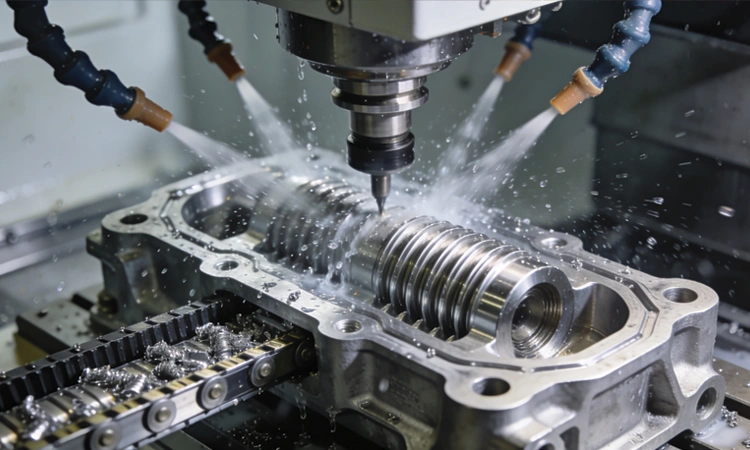
Threading is one of the most fundamental yet critically important machining operations in modern manufacturing. From fastening engine components and transmission systems in automobiles to securing mission-critical assemblies in aircraft and aerospace engines, threads play an indispensable role in ensuring structural integrity, safety, and operational reliability. In both the automotive and aerospace industries, the demand for high-precision threaded components has increased dramatically in recent years. Lightweight materials, complex component geometries, tighter tolerances, miniaturization, and higher performance expectations are driving the need for advanced threading solutions capable of delivering superior accuracy, repeatability, and productivity.
Modern threading technologies today go far beyond conventional tapping and die threading methods. Advanced CNC thread milling, thread whirling, rolling, grinding, and high-performance tapping systems are helping manufacturers produce intricate threads with exceptional precision and efficiency. Coupled with innovations in cutting tool materials, coatings, machine tools, and digital manufacturing, threading solutions are evolving rapidly to meet the stringent demands of next-generation automotive and aerospace applications.
The Critical Importance of Threads
Threads are essential mechanical features that enable assembly, fastening, sealing, motion transmission, and load distribution. In automotive and aerospace sectors, threaded components are subjected to severe operating conditions including:
- High temperatures
- Vibrations
- Cyclic stresses
- Pressure variations
- Corrosive environments
- Extreme mechanical loads
As a result, even minor imperfections in thread quality can lead to component failure, leakage, fatigue cracking, or catastrophic system malfunction.
Manufacturers therefore place enormous emphasis on:
- Dimensional accuracy
- Surface integrity
- Thread strength
- Consistent pitch and profile
- Burr-free machining
- Process repeatability
This has elevated threading from a routine machining operation to a highly engineered precision manufacturing process.
Automotive Industry: Growing Demand for Precision Threading
The automotive industry relies heavily on threaded components across virtually every subsystem.
Applications include:
- Engine blocks
- Cylinder heads
- Transmission housings
- Fuel systems
- Suspension assemblies
- Brake systems
- Steering mechanisms
- Battery enclosures for EVs
- Turbocharger components
The shift toward electric vehicles (EVs), hybrid drivetrains, and lightweight materials has introduced new threading challenges. Aluminum alloys, magnesium, composites, and high-strength steels require specialized threading approaches to maintain thread reliability without compromising productivity.
Automotive manufacturers also demand:
- High-volume production capability
- Short cycle times
- Automated machining
- Consistent quality
- Cost efficiency
This has accelerated the adoption of high-performance threading systems optimized for mass production environments.
Aerospace Industry: Zero-Defect Expectations
In aerospace manufacturing, threading requirements are even more demanding.
Aircraft engines, landing gear systems, structural assemblies, hydraulic systems, and avionics components require ultra-precise threaded features capable of withstanding extreme operational conditions.
Aerospace materials such as:
- Titanium alloys
- Inconel
- Nickel-based superalloys
- Stainless steels
- Composite materials
are notoriously difficult to machine due to their toughness, heat resistance, and tendency to generate high cutting forces.
Moreover, aerospace manufacturing operates under strict regulatory and quality standards where component traceability and process validation are mandatory.
Threading solutions for aerospace applications therefore focus on:
- Exceptional precision
- Surface integrity
- Tool reliability
- Process stability
- Minimal burr formation
- Reduced heat generation
Any threading defect can compromise safety and lead to costly rejection or rework.
Evolution of Threading Technologies
Threading technology has advanced significantly over the years, driven by increasing demands for productivity and precision.
Conventional Tapping
Tapping remains one of the most widely used threading methods, especially for internal threads in high-volume applications.
Modern tapping solutions now feature:
- Optimized flute geometries
- Advanced coatings
- High-performance carbide substrates
- Spiral point and spiral flute designs
- Synchronous tapping systems
These innovations improve chip evacuation, reduce torque, and extend tool life.
Rigid tapping systems integrated with CNC machines ensure precise synchronization between spindle rotation and feed movement, minimizing thread inaccuracies.
Thread Milling Gains Popularity
Thread milling has emerged as a preferred solution in many automotive and aerospace applications.
Unlike tapping, thread milling uses rotating multi-point cutters to generate threads through helical interpolation.
Advantages include:
- Greater flexibility
- Ability to machine different thread sizes with one tool
- Reduced risk of tool breakage
- Improved thread quality
- Better chip control
- Capability to machine large-diameter threads
Thread milling is particularly beneficial when machining expensive aerospace components where tap breakage can result in significant losses.
It also allows interrupted threading and threading close to shoulders or complex geometries.
Thread Rolling for Superior Strength
Thread rolling is a cold-forming process that creates threads through plastic deformation rather than material removal.
Widely used in automotive fastener manufacturing, thread rolling offers several advantages:
- Higher thread strength
- Improved fatigue resistance
- Better surface finish
- Faster production rates
- No chip generation
The cold-working effect enhances grain flow along the thread profile, improving mechanical properties.
Thread rolling is extensively used for bolts, studs, shafts, and fasteners in automotive applications where durability and fatigue life are critical.
Thread Grinding for Ultra-Precision Applications
Thread grinding is employed in aerospace and high-precision industries where extremely tight tolerances and superior finishes are required.
This process is ideal for:
- Hardened materials
- Ball screws
- Precision lead screws
- Aerospace fasteners
- Turbine components
Modern CNC thread grinding machines deliver micron-level accuracy and excellent profile consistency.
Advanced grinding wheel technologies and CNC controls enable highly complex thread geometries while maintaining exceptional repeatability.
Although slower than other threading methods, thread grinding remains indispensable for ultra-precision applications.
Tool Materials and Coatings Enhance Performance
Cutting tool technology has become a major factor in threading productivity.
Modern threading tools utilize advanced materials such as:
- Ultra-fine carbide
- Powder metallurgy high-speed steel
- Cermets
- Polycrystalline diamond (PCD)
- Cubic Boron Nitride (CBN)
These materials offer superior wear resistance and thermal stability.
Similarly, advanced coatings significantly improve tool performance.
Popular coatings include:
- TiN (Titanium Nitride)
- TiAlN (Titanium Aluminum Nitride)
- AlCrN (Aluminum Chromium Nitride)
- DLC (Diamond-Like Carbon)
These coatings reduce friction, minimize built-up edge formation, and extend tool life when machining difficult aerospace and automotive materials.
![Tool-Materials-Machine]() Challenges in Machining Lightweight Materials
Challenges in Machining Lightweight Materials
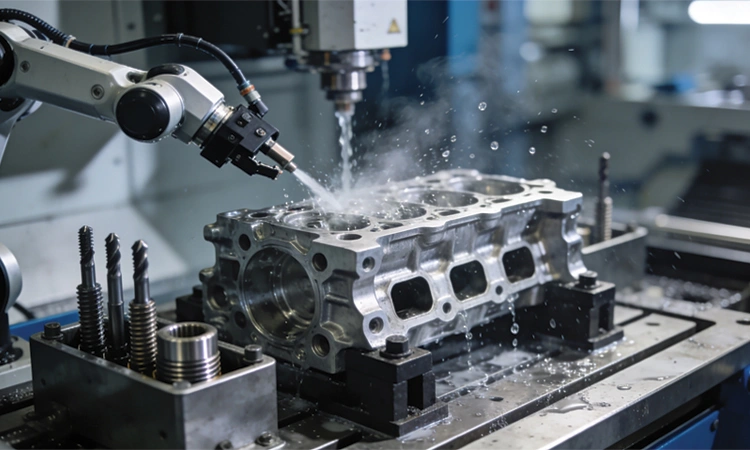 Challenges in Machining Lightweight Materials
The automotive and aerospace industries are increasingly using lightweight materials to improve fuel efficiency and reduce emissions.
However, these materials present unique threading challenges.
Aluminum Alloys
Aluminum tends to produce built-up edges and chip adhesion during threading. Specialized tool geometries and coatings are necessary to achieve clean threads.
Titanium Alloys
Titanium generates high cutting temperatures and exhibits poor thermal conductivity, accelerating tool wear.
Composite Materials
Carbon fiber composites require burr-free threading with minimal delamination.
Modern threading solutions address these challenges through optimized tool designs, coolant delivery systems, and advanced machining strategies.
High-Pressure Coolant Systems Improve Productivity
Efficient coolant delivery is essential for threading operations, especially in aerospace machining.
High-pressure coolant systems provide:
- Improved chip evacuation
- Reduced cutting temperatures
- Longer tool life
- Better surface finish
- Enhanced process reliability
Internal coolant threading tools direct coolant precisely to the cutting zone, improving performance in deep-hole and difficult-material applications.
Minimum Quantity Lubrication (MQL) systems are also gaining acceptance in automotive manufacturing due to their environmental and economic benefits.
Automation and Smart Manufacturing
Automation is transforming threading operations in both industries.
Modern threading cells now integrate:
- CNC machining centers
- Robotic loading systems
- Tool monitoring solutions
- Vision inspection systems
- In-process gauging
- Digital quality tracking
Industry 4.0 technologies enable real-time monitoring of:
- Tool wear
- Torque levels
- Thread dimensions
- Machine performance
Predictive maintenance and AI-driven analytics help manufacturers optimize threading operations and reduce downtime.
Smart threading systems improve consistency, traceability, and productivity across large production environments.
Quality Control and Inspection
Thread inspection is critical in automotive and aerospace manufacturing.
Manufacturers employ advanced metrology systems including:
- Optical inspection
- Coordinate Measuring Machines (CMMs)
- Laser scanning
- Thread gauges
- Surface roughness analyzers
Digital inspection systems ensure compliance with stringent industry standards and customer specifications.
Automated inspection further enhances production efficiency while minimizing
human error.
Sustainability in Threading Operations
Sustainability is becoming increasingly important in manufacturing.
Modern threading solutions support greener production through:
- Longer-lasting tools
- Reduced coolant usage
- Dry machining technologies
- Energy-efficient machines
- Lower material waste
Manufacturers are also adopting recyclable tooling materials and eco-friendly coolant systems to reduce environmental impact.
As industries move toward carbon reduction goals, sustainable threading practices are expected to gain greater prominence.
Future Trends in Threading Technology
The future of threading technology will be shaped by continued innovation in digital manufacturing, tooling materials, and automation.
Emerging trends include:
- AI-driven machining optimization
- Hybrid manufacturing systems
- Adaptive threading tools
- Smart sensors embedded in tooling
- Advanced additive manufacturing integration
- Nano-coatings for enhanced wear resistance
Electric vehicle production and next-generation aerospace programs will further drive demand for advanced threading solutions capable of handling new materials and complex component designs.
Manufacturers that invest in intelligent threading technologies will gain a significant competitive advantage in terms of productivity, quality, and operational efficiency.
Conclusion
Threading solutions have evolved into highly sophisticated manufacturing technologies essential to the automotive and aerospace industries. From advanced tapping and thread milling to ultra-precision grinding and rolling, modern threading systems are enabling manufacturers to achieve higher productivity, superior quality, and greater process reliability.
As component complexity increases and material technologies advance, the importance of precision threading will continue to grow. Manufacturers must therefore adopt innovative tooling, automation, and digital solutions to meet evolving industry demands.
In the years ahead, advanced threading technologies will remain a cornerstone of precision engineering, supporting safer vehicles, more efficient aircraft, and the next generation of high-performance manufacturing.