India’s Cutting Tools Industry : Opportunities in Global Supply Chains

The global manufacturing landscape is undergoing a significant transformation. Rising geopolitical uncertainties, supply chain diversification, technological advancements, and the search for resilient sourcing destinations are encouraging manufacturers worldwide to rethink their procurement strategies. In this evolving scenario, India’s cutting tools industry stands at a promising crossroads. Long regarded as a dependable supplier to the domestic engineering sector, Indian cutting tool manufacturers are now increasingly positioning themselves as strategic partners in global supply chains. With the Government’s emphasis on Make in India, Production Linked Incentive (PLI) schemes, infrastructure development, and export promotion, coupled with the rapid growth of automotive, aerospace, medical devices, electronics, and precision engineering sectors, India offers an ideal environment for the cutting tools industry to expand its global footprint.
A Strong Domestic Foundation
India’s cutting tools industry comprises a healthy mix of multinational companies, established Indian manufacturers, and a vibrant ecosystem of small and medium enterprises. The industry manufactures a wide spectrum of products including:
- Carbide inserts
- Solid carbide end mills
- Drills and reamers
- Taps and thread mills
- Turning tools
- Milling cutters
- Tool holders
- Indexable tooling systems
- PCD and CBN cutting tools
- Special-purpose tools
Indian manufacturers today serve demanding sectors such as automotive, railways, defence, aerospace, die & mould, energy, general engineering, heavy equipment, and medical components.
The increasing adoption of CNC machining centres, multitasking machines, robotics, and smart manufacturing has also elevated the quality expectations from cutting tools, encouraging Indian manufacturers to invest heavily in technology.
The Global Supply Chain Shift
One of the biggest opportunities before the Indian cutting tools industry arises from the ongoing restructuring of global supply chains.
For decades, many global OEMs depended heavily on single-country sourcing. Recent disruptions-including the pandemic, geopolitical tensions, shipping uncertainties, and rising manufacturing costs-have prompted companies to diversify their supplier base.
The “China Plus One” strategy has accelerated this transition. Global manufacturers are actively evaluating alternative sourcing destinations capable of offering quality, reliability, competitive pricing, and engineering capability.
India fits this requirement remarkably well.
The country offers:
- Competitive manufacturing costs
- Large engineering talent pool
- Growing machine tool industry
- Strong metallurgy capabilities
- Improved logistics infrastructure
- Stable democratic framework
- Increasing ease of doing business
- Expanding export ecosystem
These advantages are encouraging international buyers to source cutting tools and tooling solutions from Indian manufacturers.
Growing Export Potential
India’s cutting tool exports have witnessed steady growth over the years. While traditional markets such as Europe and North America continue to remain important, Indian manufacturers are increasingly expanding into:
- Southeast Asia
- Middle East
- Latin America
- Africa
- Australia
- Eastern Europe
Customers appreciate India’s ability to offer high-quality products at competitive prices, supported by strong engineering services and application expertise.
Rather than competing solely on price, Indian companies are increasingly differentiating themselves through customised tooling solutions, rapid development cycles, and technical support.
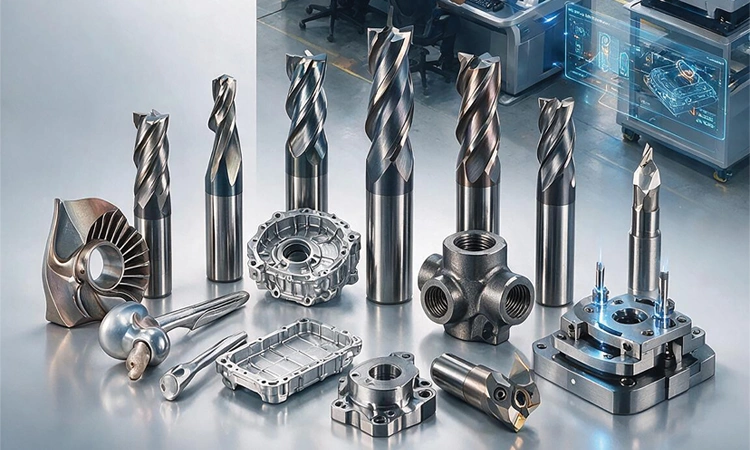 Technology Upgradation Driving Competitiveness
Today’s cutting tools are no longer simple pieces of carbide or high-speed steel. They are precision-engineered products involving advanced material science, sophisticated geometries, nano-scale coatings, and application-specific designs.
Indian manufacturers are investing in:
- Five-axis CNC tool grinding machines
- Laser measurement systems
- Advanced coating technologies
- Simulation software
- CAD/CAM-based tool design
- Digital inspection systems
- Automated manufacturing cells
Many companies now produce tools that match international standards in terms of dimensional accuracy, tool life, surface finish, and productivity.
The adoption of PVD, CVD, diamond coatings, and advanced carbide grades has significantly enhanced the global competitiveness of Indian cutting tools.
Customisation: India’s Competitive Edge
Global manufacturers increasingly seek customised cutting solutions rather than standard catalogue products.
Indian companies have demonstrated remarkable agility in designing application-specific tools for industries such as:
- Aerospace machining
- Medical implants
- Electric vehicle components
- Precision moulds
- Oil & gas equipment
- Defence components
- Semiconductor equipment
The ability to collaborate closely with customers during tool development gives Indian manufacturers a distinct advantage over larger global suppliers that often operate with longer response cycles.
Quick prototyping and engineering flexibility have become major differentiators.
Supporting the EV Revolution
The rapid growth of electric vehicles worldwide presents exciting opportunities.
EV manufacturing requires machining of:
- Aluminium housings
- Battery trays
- Motor shafts
- Rotor assemblies
- Transmission components
- Lightweight structural parts
These applications demand specialised cutting tools capable of machining aluminium alloys, composites, hardened steels, and difficult-to-machine materials with high productivity.
Indian cutting tool manufacturers are already developing solutions specifically for EV production, opening new export opportunities.
Aerospace and Defence: High-Value Markets
India’s aerospace and defence manufacturing capabilities are expanding rapidly.
As global aerospace OEMs increase sourcing from India, demand for premium cutting tools is rising.
Machining aerospace materials such as titanium, Inconel, nickel-based superalloys, and high-strength steels requires sophisticated tooling technologies.
Indian manufacturers investing in these specialised segments can become valuable partners in global aerospace supply chains.
Although entry barriers remain high, the value addition and long-term business potential are significant.
Industry 4.0 and Smart Tooling
Digital manufacturing is transforming machining operations worldwide.
Modern cutting tools increasingly incorporate:
- Tool identification systems
- RFID-enabled holders
- Digital tool management
- Tool life monitoring
- Predictive maintenance integration
Indian manufacturers are gradually integrating smart technologies into their tooling solutions, enabling customers to optimise productivity and reduce downtime.
Integration with Manufacturing Execution Systems (MES), digital twins, and AI-based machining optimisation will further strengthen India’s competitiveness in global markets.
Sustainability as a Business Opportunity
Sustainability is becoming a critical purchasing criterion for global manufacturers.
Customers increasingly prefer suppliers who demonstrate:
- Energy-efficient manufacturing
- Reduced carbon footprint
- Waste minimisation
- Recycling initiatives
- Sustainable packaging
- Responsible sourcing practices
Cutting tool manufacturers can contribute significantly by developing tools that improve machining efficiency, reduce energy consumption, minimise coolant usage, and extend tool life.
Longer-lasting tools translate directly into lower material consumption and improved sustainability for end users.
Indian manufacturers embracing green manufacturing practices can strengthen their appeal in export markets where Environmental, Social and Governance (ESG) considerations increasingly influence supplier selection.
Challenges That Need Attention
Despite encouraging opportunities, certain challenges remain.
The industry continues to face:
- Dependence on imported tungsten carbide powders and specialty raw materials
- Volatility in raw material prices
- Competition from low-cost imports
- Rapid technological changes
- Shortage of highly skilled tooling specialists
- High investment requirements for advanced manufacturing equipment
- Need for greater investment in R&D and indigenous tool material development
Addressing these issues will require stronger collaboration among industry, academia, research institutions, and government agencies.
The coming decade could well mark India’s transition from a significant domestic market for cutting tools to a globally recognised manufacturing and sourcing hub. By embracing innovation, strengthening indigenous capabilities, and aligning with the evolving needs of international industries, the Indian cutting tools sector is poised to become an indispensable link in global manufacturing supply chains.
Building a Global Brand
While India enjoys a reputation for engineering excellence, many global buyers still associate premium cutting tools with established brands from Germany, Japan, Switzerland, and the United States.
Indian manufacturers must therefore invest not only in technology but also in branding, quality certifications, customer support, and international marketing.
Participation in leading global exhibitions, technical seminars, digital marketing initiatives, and strategic partnerships can significantly enhance visibility.
Equally important is building long-term trust through consistent quality, on-time delivery, and responsive after-sales support.
The Road Ahead
The future of India’s cutting tools industry is closely linked with the country’s broader manufacturing ambitions. As India advances toward becoming a global manufacturing hub, demand for high-performance cutting tools will continue to rise domestically while creating stronger export opportunities.
The convergence of favourable government policies, expanding industrial capacity, growing engineering expertise, and global supply chain diversification provides a rare window of opportunity. Companies that invest in advanced manufacturing technologies, innovation, digital capabilities, sustainability, and customer-centric engineering will be best positioned to capture a larger share of international markets.
Rather than being viewed merely as low-cost suppliers, Indian cutting tool manufacturers are steadily evolving into providers of high-value, precision-engineered solutions. Their ability to deliver customised products, rapid technical support, and reliable quality positions them as trusted partners for global OEMs.
The coming decade could well mark India’s transition from a significant domestic market for cutting tools to a globally recognised manufacturing and sourcing hub. By embracing innovation, strengthening indigenous capabilities, and aligning with the evolving needs of international industries, the Indian cutting tools sector is poised to become an indispensable link in global manufacturing supply chains.