Five-Axis Machining – New Demands on Cutting Tools
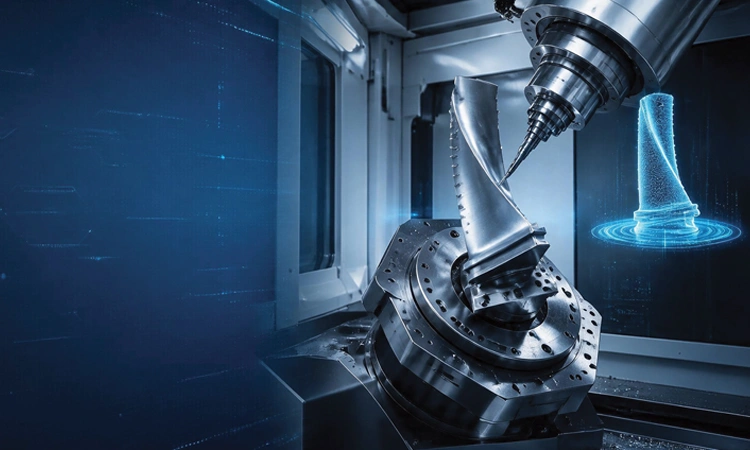
The rapid evolution of manufacturing has transformed five-axis machining from a niche technology into a mainstream production solution. Once reserved primarily for aerospace and die & mould applications, five-axis machining is now widely employed in the automotive, medical, energy, defence, and precision engineering sectors. Its ability to machine complex geometries in a single setup, reduce production time, and achieve exceptional accuracy has made it indispensable for modern manufacturers. However, the widespread adoption of five-axis machining has also placed new and far more demanding expectations on cutting tools. Traditional tooling designed for three-axis machining is often unable to exploit the full capabilities of advanced machining centres. Today’s cutting tools must withstand higher spindle speeds, varying tool engagement angles, longer reach, dynamic toolpaths, and increasingly difficult workpiece materials while maintaining precision, productivity, and reliability.
The Rise of Five-Axis Machining
Unlike conventional three-axis machines that move along the X, Y, and Z axes, five-axis machining incorporates two additional rotary axes, enabling the cutting tool to approach the workpiece from virtually any direction.
The benefits are substantial:
- Complex components can be completed in a single setup.
- Multiple fixtures and repositioning are eliminated.
- Shorter cutting tools can often be used.
- Surface finish improves significantly.
- Geometric accuracy is enhanced.
- Production time is considerably reduced.
These advantages have made five-axis machining the preferred choice for manufacturing turbine blades, impellers, moulds, medical implants, aerospace structural components, compressor wheels, precision dies, and intricate automotive parts.
Yet these capabilities also expose cutting tools to much more demanding operating conditions.
Complex Tool Orientations
One of the defining characteristics of five-axis machining is the continuous change in tool orientation.
During machining, the tool constantly tilts and rotates to maintain optimum contact with the workpiece. Unlike conventional machining, where cutting conditions remain relatively stable, five-axis machining subjects the cutting edge to continuously changing engagement angles.
As a result, cutting tools must deliver consistent performance regardless of cutting direction.
Tool manufacturers therefore focus on:
- Symmetrical cutter geometry
- Uniform cutting edge strength
- Precision-balanced tool bodies
- Accurate runout control
- Stable insert positioning
These characteristics ensure predictable cutting behaviour throughout complex tool movements.
 Greater Demands on Tool Rigidity
Five-axis machining frequently involves deep cavities and hard-to-reach features.
Although machine kinematics often allow shorter tools than conventional setups, certain applications still require long tool overhangs.
Any lack of rigidity can result in:
- Chatter
- Tool deflection
- Dimensional inaccuracies
- Poor surface finish
- Premature tool failure
Modern tooling addresses these issues through optimized carbide substrates, tapered neck designs, reinforced shanks, anti-vibration toolholders, and shrink-fit or hydraulic clamping systems that maximize rigidity while minimizing runout.
Higher Spindle Speeds and Feed Rates
Modern five-axis machining centres are equipped with high-speed spindles capable of operating at 20,000 to 40,000 rpm-and even higher in specialized applications.
Cutting tools must therefore withstand:
- Higher cutting temperatures
- Increased centrifugal forces
- Rapid acceleration and deceleration
- Continuous dynamic loading
This has driven the development of advanced carbide grades with improved toughness and hot hardness.
Equally important are modern coatings such as:
- AlTiN
- TiAlN
- AlCrN
- Nano-composite PVD coatings
- Diamond coatings for composite materials
These coatings reduce friction, resist oxidation, improve heat resistance, and significantly extend tool life.
Machining Difficult Materials
Five-axis machining is increasingly used on materials that are notoriously difficult to machine.
These include:
- Titanium alloys
- Inconel and other nickel-based superalloys
- Hardened tool steels
- Stainless steels
- Cobalt-chrome alloys
- Carbon fibre reinforced composites (CFRP)
- Ceramic matrix composites
Each material presents unique challenges involving heat generation, work hardening, abrasive wear, or chip evacuation.
Modern cutting tools are therefore designed with specialized edge preparations, chip breakers, flute geometries, and substrate compositions tailored for specific materials.
Rather than offering a “one-tool-for-all” solution, manufacturers increasingly provide application-specific tooling.
 Tool Balance Becomes Critical
At spindle speeds exceeding 20,000 rpm, even slight imbalance can generate excessive vibration.
Consequences include:
- Poor surface finish
- Reduced dimensional accuracy
- Increased spindle wear
- Lower tool life
- Higher noise levels
Today’s premium cutting tools undergo precision balancing during manufacture to extremely tight tolerances.
Balanced toolholders-including HSK, Capto, shrink-fit, and hydraulic systems-have become standard companions for five-axis machining.
Advanced Tool Geometries
Modern five-axis machining demands cutters capable of maintaining smooth cutting action under continuously changing engagement conditions.
Recent innovations include:
- Variable helix angles
- Variable pitch cutters
- Unequal flute spacing
- Asymmetrical chip splitters
- Barrel cutters
- Lens-shaped cutters
- Circle-segment cutters
Among these, barrel cutters have become particularly popular in die and mould manufacturing.
Because their effective cutting radius is much larger than that of conventional ball nose cutters, they permit significantly larger stepovers while maintaining identical surface quality.
The result is dramatic reductions in machining time-often by 50 to 80 percent in semi-finishing operations.
Digital Tool Management
Five-axis machining has become closely integrated with Industry 4.0.
Modern cutting tools increasingly incorporate digital capabilities through:
- RFID identification
- Tool presetting systems
- Tool life monitoring
- Automatic tool measurement
- Digital twins
- Cloud-connected tool databases
CAM software can automatically recognize tooling characteristics and generate optimized machining strategies.
Machine operators receive real-time information on tool wear, remaining life, and replacement schedules, minimizing unexpected failures.
Coolant Delivery Matters More Than Ever
Complex five-axis operations often create difficult chip evacuation conditions.
Effective coolant delivery has become a major design consideration.
Modern tooling incorporates:
- Internal coolant channels
- High-pressure coolant delivery
- Through-tool cooling
- Precision coolant nozzles
- Minimum Quantity Lubrication (MQL) compatibility
Proper coolant application reduces cutting temperatures, improves chip evacuation, minimizes built-up edge formation, and extends tool life considerably.
Sustainability Drives Tool Innovation
Manufacturers are under increasing pressure to reduce environmental impact while improving productivity.
Tool manufacturers are responding with:
- Longer-lasting carbide grades
- Regrindable solid carbide tools
- Indexable systems that minimize waste
- Energy-efficient cutting geometries
- Coatings that reduce coolant requirements
- Tools compatible with dry machining and MQL
These innovations not only lower operating costs but also support sustainable manufacturing initiatives.
 Collaboration Between CAM and Tool Design
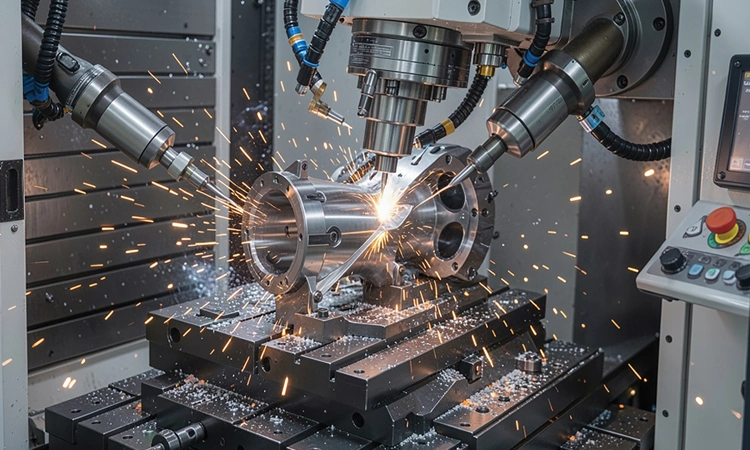
Perhaps the most significant change in five-axis machining is the close relationship between CAM software and cutting tool design.
Toolpaths generated by modern CAM systems are specifically optimized for cutter geometry.
Dynamic milling, adaptive machining, trochoidal paths, and constant-engagement machining ensure that tools experience consistent cutting loads, reducing vibration and extending tool life.
As a result, cutting tool manufacturers increasingly collaborate with CAM developers to ensure their products deliver maximum performance.
Looking Ahead
The next generation of cutting tools will become even smarter.
Artificial intelligence is expected to play an important role in optimizing cutting parameters based on real-time machining data. Embedded sensors capable of monitoring vibration, temperature, and cutting forces may soon provide continuous feedback to machine controls, enabling adaptive machining and predictive maintenance.
Advances in coating technology, additive manufacturing of tool bodies, hybrid materials, and digital tool management will further enhance tool performance while supporting greater automation and sustainability.
Conclusion
Five-axis machining has fundamentally changed the way complex components are manufactured, offering unprecedented flexibility, accuracy, and productivity. However, these advantages can only be fully realized with cutting tools specifically engineered for the demands of multi-axis machining.
Today’s cutting tools are no longer passive accessories-they are highly engineered precision systems incorporating advanced materials, sophisticated geometries, high-performance coatings, balanced designs, and digital intelligence. Their ability to withstand dynamic cutting conditions while delivering consistent accuracy and extended tool life is critical to the success of five-axis machining.
As industries continue to pursue greater precision, shorter lead times, and smarter manufacturing, the evolution of cutting tools will remain closely intertwined with the advancement of five-axis machining, ensuring that both technologies continue to push the boundaries of modern manufacturing.