Connected Tool Rooms – The Future of Tool Management
In today’s highly competitive manufacturing environment, every second of machine uptime counts. Modern machining centres are capable of delivering exceptional productivity, but their performance is only as good as the cutting tools that support them. While manufacturers have invested heavily in advanced CNC machines, robotics, and automation, many tool rooms still rely on conventional methods of storing, issuing, tracking, and managing cutting tools. This gap often leads to unnecessary tool shortages, excess inventory, production delays, and higher machining costs. The concept of the Connected Tool Room is changing this scenario. By integrating digital technologies, automation, Industrial Internet of Things (IIoT), cloud computing, and intelligent software, connected tool rooms are transforming traditional tool management into a strategic manufacturing function. They ensure that the right tool is available at the right machine, at the right time, while providing complete visibility into tool usage, inventory, and performance. As smart manufacturing and Industry 4.0 continue to gain momentum, connected tool rooms are emerging as an essential component of modern production systems.
From Storage Room to Strategic Asset
Traditionally, the tool room has been viewed as a storage facility for cutting tools, tool holders, inserts, gauges, and accessories. Tool issuance was often handled manually, with records maintained on paper or simple spreadsheets. This approach frequently resulted in overstocking, misplaced tools, duplicate purchases, and limited traceability.
A connected tool room, on the other hand, functions as an intelligent, data-driven hub. Every tool is digitally identified, monitored, and tracked throughout its lifecycle-from procurement and storage to usage, reconditioning, and eventual disposal. This shift transforms the tool room into a strategic asset that directly contributes to productivity, cost control, and operational excellence.
Digital Inventory Management
One of the biggest advantages of connected tool rooms is real-time inventory visibility.
Advanced tool management software continuously tracks stock levels, tool locations, minimum inventory thresholds, and consumption patterns. Barcode labels, QR codes, or RFID tags allow every tool to be uniquely identified and traced.
When a tool is issued to a machine operator, the system records:
- Tool identity
- Machine assignment
- Operator details
- Date and time
- Quantity issued
- Expected tool life
Managers gain instant access to inventory status, enabling informed purchasing decisions and preventing both shortages and excess stock.
Automated Tool Dispensing
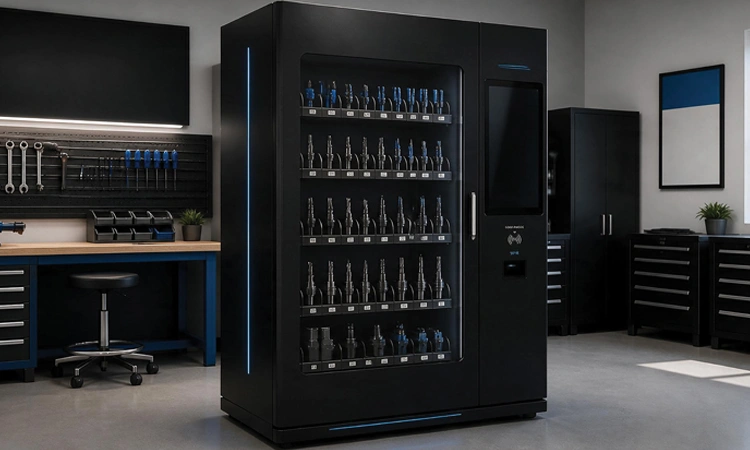
Many modern factories are replacing conventional storage cabinets with automated tool vending systems.
These intelligent dispensing units function much like industrial vending machines. Operators authenticate themselves using employee cards, biometric systems, or passwords before accessing tools.
The system automatically records every transaction, ensuring complete accountability.
Benefits include:
- Reduced tool wastage
- Controlled access
- Elimination of unauthorised withdrawals
- Improved inventory accuracy
- Faster tool issuance
- Better utilisation of expensive tooling
Automated dispensing also allows round-the-clock access without requiring dedicated tool room personnel for every shift.
 Real-Time Tool Tracking
A connected tool room provides complete traceability throughout a tool’s lifecycle.
Manufacturers can determine:
- Which machine used the tool
- Number of components produced
- Remaining tool life
- Number of regrinding cycles
- Coating history
- Maintenance schedule
- Current storage location
This visibility helps optimise tool utilisation while ensuring timely replacement before catastrophic failure occurs.
Historical data also enables engineers to identify recurring issues and improve machining processes.
Integration with CNC Machines
The future of tool management lies in seamless communication between the tool room and the shop floor.
Modern CNC machines can exchange information with central tool management software regarding:
- Tool loading
- Tool wear
- Tool breakage
- Tool offsets
- Remaining life
- Replacement requirements
This integration enables proactive planning rather than reactive troubleshooting.
Instead of discovering tool shortages during production, replacement tools can be prepared well in advance, reducing machine downtime.
Predictive Tool Life Management
Every cutting tool has a finite life. Replacing it too early increases tooling costs, while replacing it too late risks poor surface finish, dimensional inaccuracies, and machine downtime.
Connected tool rooms leverage data analytics and AI to predict the optimal replacement point.
Factors such as:
- Material being machined
- Cutting speed
- Feed rate
- Depth of cut
- Machine conditions
- Historical performance
are analysed to estimate remaining tool life accurately.
This predictive approach reduces both premature replacement and unexpected tool failures.
Data-Driven Decision Making
One of the most valuable outcomes of connected tool rooms is the wealth of actionable data they generate.
Manufacturers can analyse:
- Tool consumption by department
- Cost per component
- Tool performance by supplier
- Machine-wise tooling expenses
- Operator-wise usage trends
- Scrap caused by tooling issues
- Tool life comparisons
These insights enable continuous improvement and help optimise machining strategies.
Rather than relying on assumptions, managers can make decisions based on measurable performance indicators.
Supporting Lights-Out Manufacturing
As automation expands, many factories are operating unmanned shifts, particularly during nights and weekends.
Connected tool rooms play a crucial role in supporting lights-out manufacturing.
Automated systems ensure:
- Required tools are available before production begins.
- Tool inventory is verified in advance.
- Replacement tools are staged automatically.
- Alerts are generated if stock levels fall below critical limits.
This preparedness minimises the risk of production interruptions during unattended operations.
Cloud Connectivity and Remote Monitoring
Cloud-based tool management systems enable authorised personnel to monitor tool room operations from anywhere.
Plant managers can review:
- Inventory levels
- Tool consumption
- Purchase requirements
- Machine utilisation
- Tooling costs
- Supplier performance
Remote access also facilitates collaboration across multiple manufacturing locations, allowing companies to standardise tooling practices and optimise inventory at the enterprise level.
Supporting Sustainability
Efficient tool management contributes directly to sustainable manufacturing.
Connected tool rooms help reduce environmental impact by:
- Minimising excess inventory
- Reducing obsolete stock
- Maximising tool life
- Tracking reconditioning cycles
- Lowering material waste
- Optimising procurement
- Reducing emergency shipments
Many cutting tools can be reconditioned several times. Digital tracking ensures that tools are re-ground and recoated at the appropriate intervals, extending their usable life while reducing raw material consumption.
Integration with Enterprise Systems
Modern connected tool rooms are increasingly integrated with ERP, MES, and production planning systems.
Such integration enables automatic:
- Purchase requisitions
- Inventory updates
- Tool reservations
- Cost allocation
- Job scheduling
- Tool availability verification
This creates a seamless flow of information across manufacturing operations, improving coordination between production, purchasing, stores, and maintenance.
Challenges in Implementation
While the benefits are compelling, implementing a connected tool room requires careful planning.
Manufacturers must address challenges such as:
- Initial investment in software and automation
- Standardisation of tooling data
- Integration with legacy systems
- Employee training
- Cybersecurity
- Change management
However, the long-term gains in productivity, inventory optimisation, and reduced downtime often justify the investment.
Small and medium enterprises can also adopt connected tool management incrementally, beginning with digital inventory systems before progressing to automated dispensing, machine connectivity, and advanced analytics.
The Road Ahead
The evolution of connected tool rooms is closely aligned with the broader digital transformation of manufacturing. Emerging technologies such as Artificial Intelligence, Digital Twins, augmented reality, and collaborative robotics will further enhance tool management in the years ahead.
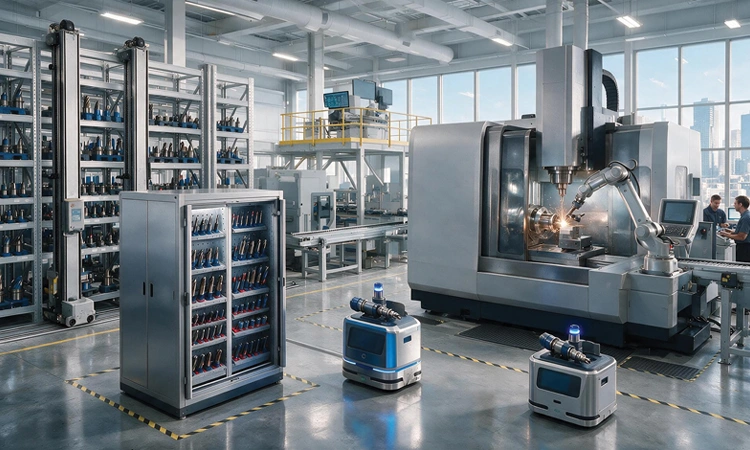
Future systems may automatically recommend optimal cutting parameters based on tool history, forecast demand using production schedules, and coordinate with autonomous mobile robots (AMRs) to deliver tools directly to machines. Integration with digital twins could simulate tooling performance before machining begins, reducing trial runs and accelerating process optimisation.
As manufacturing moves toward greater automation and data-driven decision-making, the tool room will no longer be a passive storage area but an intelligent control centre that ensures uninterrupted production, lower costs, and higher machining efficiency.
Conclusion
The connected tool room represents a fundamental shift in how manufacturers manage one of their most valuable production assets-cutting tools. By combining automation, digital tracking, real-time analytics, and seamless integration with machine tools and enterprise systems, it delivers greater visibility, accountability, and operational efficiency.
For Indian manufacturers striving to compete in global markets, adopting connected tool room practices is no longer merely an operational upgrade-it is a strategic necessity. Those who embrace intelligent tool management will be better positioned to reduce costs, improve productivity, support smart manufacturing initiatives, and meet the increasingly demanding expectations of customers worldwide.
In the era of Industry 4.0, the future of tool management is undeniably connected, intelligent, and data-driven. Manufacturers that invest in this transformation today will gain a lasting competitive edge in tomorrow’s digital factory.