High Performance Coatings & Enhanced Tool
Life Advanced Surface Technologies Transform Modern Machining
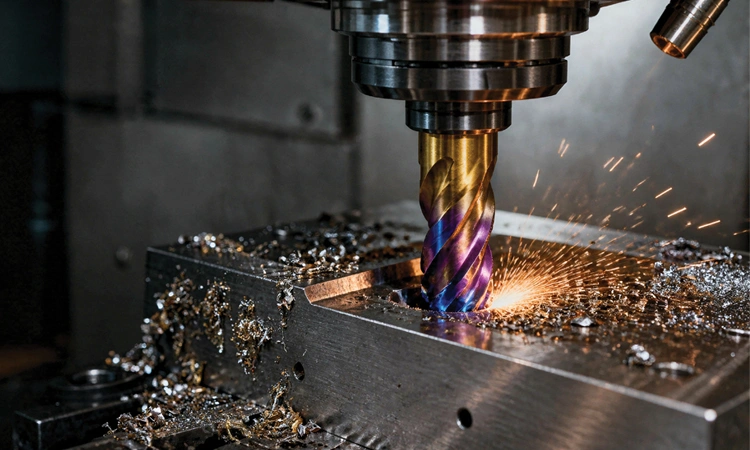
In today’s highly competitive manufacturing environment, productivity, precision, and cost efficiency have become the defining parameters of success. Industries such as automotive, aerospace, die & mould, medical engineering, railways, defense, and energy are constantly seeking ways to improve machining performance while reducing downtime and operational costs. Amid these demands, high performance coatings for cutting tools have emerged as one of the most significant technological advancements in modern machining. Cutting tools are subjected to extreme conditions during machining operations. High temperatures, friction, mechanical stress, abrasion, and chemical wear continuously affect tool performance and durability. Traditional tooling materials alone are often insufficient to withstand these harsh operating environments, especially when machining hardened steels, titanium alloys, composites, and superalloys. High performance coatings have revolutionized the cutting tool industry by dramatically enhancing tool life, machining speeds, wear resistance, and overall productivity. Today, coatings are no longer considered optional enhancements; they have become integral to advanced cutting tool engineering.
Understanding the Role of Tool Coatings
Tool coatings are thin layers of specialized materials applied to the surface of cutting tools to improve their performance characteristics. Although these coatings are often only a few microns thick, they significantly influence machining efficiency and tool longevity.
The primary purpose of coatings is to reduce friction, minimize heat generation, improve hardness, resist oxidation, and protect the tool substrate from wear and chemical degradation. Coatings also help maintain sharp cutting edges for longer durations, resulting in improved surface finishes and dimensional accuracy.
By enhancing the interaction between the cutting tool and the workpiece material, coatings enable manufacturers to achieve higher cutting speeds and feeds without compromising performance.
Evolution of Coating Technologies
The development of cutting tool coatings has evolved considerably over the years. Early coating technologies primarily focused on improving hardness and wear resistance. However, modern coatings are now engineered to address multiple machining challenges simultaneously.
Titanium Nitride (TiN) was among the earliest widely adopted coatings due to its excellent hardness and reduced friction characteristics. Over time, more advanced coatings such as Titanium Carbonitride (TiCN), Titanium Aluminum Nitride (TiAlN), Aluminum Titanium Nitride (AlTiN), Chromium Nitride (CrN), and Diamond-Like Carbon (DLC) coatings emerged.
Today, nanocomposite coatings and multilayer coating structures are pushing performance boundaries even further. These coatings combine different material layers to optimize toughness, thermal stability, oxidation resistance, and wear protection.
Advanced coatings are specifically designed for targeted applications, enabling superior performance under specialized machining conditions.
PVD and CVD Technologies Dominate the Industry
Two major coating technologies dominate the cutting tool industry: Physical Vapor Deposition (PVD) and Chemical Vapor Deposition (CVD).
PVD coatings are applied at relatively lower temperatures and are known for producing hard, thin, and smooth coating layers with excellent edge retention. They are particularly suitable for sharp cutting tools such as end mills, drills, and taps.
CVD coatings, on the other hand, are deposited at higher temperatures and typically provide thicker coatings with superior wear resistance and thermal protection. These coatings are widely used in turning inserts and heavy machining applications.
Both technologies continue to evolve, with manufacturers constantly improving deposition techniques, coating adhesion, and surface uniformity to achieve better machining performance.
Machining Difficult Materials Demands Better Coatings
Modern industries increasingly machine difficult-to-cut materials such as titanium alloys, Inconel, hardened steels, composites, and heat-resistant superalloys. These materials generate intense heat and stress during machining, causing rapid tool wear.
High performance coatings have become essential for addressing these challenges. AlTiN and TiAlN coatings, for example, offer excellent thermal stability and oxidation resistance, making them ideal for high-speed machining of hardened materials.
Similarly, diamond coatings are widely used for machining non-ferrous materials, composites, graphite, and aluminum alloys due to their exceptional hardness and low friction properties.
Without advanced coatings, machining many modern engineering
materials would be economically impractical.
Enhanced Tool Life Improves Productivity
One of the most significant benefits of high performance coatings is extended tool life. Longer-lasting tools reduce machine downtime associated with frequent tool changes and improve overall manufacturing efficiency.
Enhanced tool life also contributes to consistent machining quality, reduced rejection rates, and lower tooling costs per component.
In automated manufacturing environments and unmanned machining systems, predictable tool performance is critical. Coated tools provide greater process reliability and enable manufacturers to maintain stable production cycles with minimal interruptions.
The ability to run machines at higher cutting speeds and feeds further boosts productivity, making coated tools a valuable investment despite their higher initial cost.
 Heat Management is Critical
Heat generation remains one of the biggest challenges in metal cutting operations. Excessive heat not only damages the cutting edge but can also affect workpiece quality and dimensional accuracy.
Modern coatings act as thermal barriers, reducing heat transfer to the cutting tool substrate and protecting it from thermal degradation. This allows tools to operate effectively even under extreme cutting temperatures.
Some advanced coatings are specifically designed for dry machining and minimum quantity lubrication (MQL) applications, helping manufacturers reduce coolant usage and move toward more sustainable machining practices.
Improved heat management also enables higher machining stability and longer uninterrupted production runs.
Nano-Coatings and Multilayer Structures
Recent innovations in coating technologies have led to the development of nano-structured and multilayer coatings capable of delivering extraordinary performance.
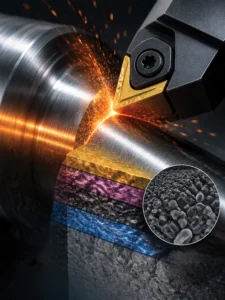
Nanocomposite coatings feature extremely fine grain structures that improve hardness while maintaining toughness. These coatings offer superior resistance to crack propagation, abrasion, and thermal fatigue.
Multilayer coatings combine different materials in alternating layers, each contributing specific performance characteristics such as toughness, lubrication, oxidation resistance, or wear protection.
These advanced coating architectures allow manufacturers to customize tool performance for highly specialized applications.
Coatings Support Sustainable Manufacturing
Sustainability has become an increasingly important focus in modern manufacturing, and high performance coatings contribute significantly toward achieving environmental goals.
Longer tool life reduces material consumption and waste generation. Dry machining capabilities reduce coolant usage, lowering environmental impact and disposal costs.
Improved machining efficiency also reduces energy consumption by minimizing machining time and enhancing process stability.
Additionally, coated tools help manufacturers achieve higher productivity with fewer tooling resources, supporting more sustainable manufacturing operations overall.
Challenges in Coating Technology
Despite their numerous advantages, high performance coatings also present certain challenges.
The coating process itself requires sophisticated equipment, strict process control, and significant investment. Poor coating adhesion or incorrect coating selection can negatively impact tool performance.
Different machining applications require specific coating combinations, and selecting the right coating for a particular material and cutting condition demands considerable expertise.
Furthermore, as machining technologies continue to evolve, coating developers must constantly innovate to keep pace with emerging manufacturing requirements.
India’s Growing Potential in Coating Technologies
India’s rapidly expanding manufacturing sector presents enormous opportunities for the cutting tool coatings industry. Growth in aerospace, defense, automotive, electronics, and die & mould manufacturing is driving demand for advanced coated tooling solutions.
Several domestic and international companies are investing in coating facilities, R&D centers, and application engineering support within India. The increasing adoption of CNC machining, automation, and high-speed manufacturing is further accelerating demand for premium coated tools.
However, continued investment in research, skill development, and indigenous coating technologies will be essential for strengthening India’s position in the global tooling market.
The Future of Tool Coatings
The future of high performance coatings lies in intelligent surface engineering, advanced nanotechnology, AI-driven coating optimization, and application-specific customization.
Researchers are exploring self-lubricating coatings, adaptive coatings capable of responding to machining conditions, and ultra-hard coating materials with unprecedented thermal resistance.
As manufacturing shifts toward higher precision, automation, and sustainability, cutting tool coatings will play an even more critical role in enabling efficient and reliable machining operations.
High performance coatings are no longer merely protective layers-they are strategic productivity enhancers that define the performance limits of modern cutting tools.
In the evolving landscape of advanced manufacturing, the synergy between innovative coating technologies and cutting tool engineering will continue to shape the future of machining
excellence.