Reamers – The Unsung Heroes of Precision Machining
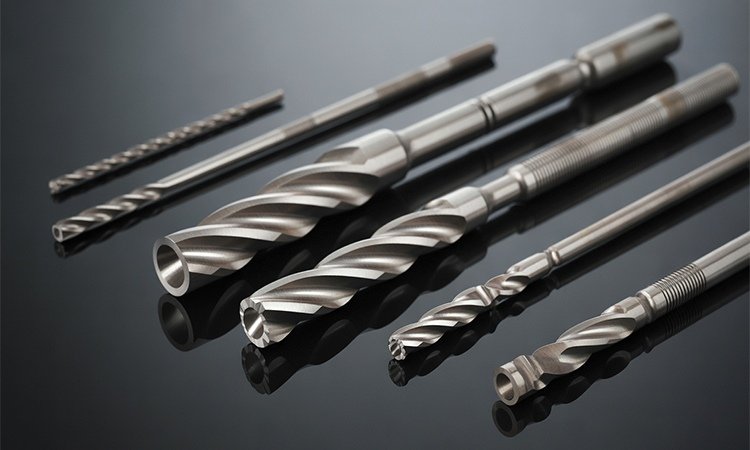
In the world of metal cutting, tools like drills, end mills, and inserts often take center stage. Yet, behind every precision-fit component or perfect hole diameter lies a lesser-known but equally essential tool — the reamer. Though modest in appearance and function, reamers play a vital role in achieving high-accuracy holes, superior surface finish, and tight dimensional tolerances that other tools simply cannot deliver.
The Purpose of a Reamer
A reamer is a multi-edged cutting tool designed primarily for finishing and sizing holes. While drilling creates the initial hole, it rarely provides the precision required for high-performance assemblies. A reamer follows the drill, removing a minimal amount of material — usually between 0.1 mm and 0.3 mm — to bring the hole to an exact diameter with superior surface quality. This makes the reamer indispensable wherever fit, alignment, and smoothness are critical, such as in the manufacture of engine components, hydraulic systems, aircraft parts, and precision molds.
Precision Beyond Drilling
Drilling, while fast, often results in slight deviations due to tool wear, deflection, or vibration. A reamer corrects these inaccuracies by cutting a small, uniform layer from the inner surface of the drilled hole, achieving tolerances as fine as IT6 or better and surface finishes up to Ra 0.2 µm. This is especially important for press-fit, dowel, and bearing holes, where even a few microns of error can affect performance or assembly. In short, the reamer brings the drilled hole “to perfection,” transforming rough accuracy into engineering-grade precision.
Types and Materials
Reamers come in various forms depending on the application — hand reamers, machine reamers, chucking reamers, adjustable reamers, and
taper reamers. While hand reamers are used for manual finishing or maintenance work, machine reamers are designed for high-speed, automated production.
Material-wise, High-Speed Steel (HSS) reamers are popular for general use, offering a good balance of toughness and wear resistance. Carbide reamers, on the other hand, are preferred for high-volume production or harder materials due to their superior hardness and heat resistance. For specialized tasks, coated reamers (with TiN, TiCN, or AlTiN coatings) enhance lubricity and extend tool life.
Applications
From the automotive sector to aerospace, energy, and medical device manufacturing, reamers are essential wherever dimensional precision is non-negotiable. For instance:
- In automotive engines, reamers ensure perfect alignment in connecting rods and crankcases.
- In aerospace, they guarantee tight-tolerance bores in structural and turbine components.
- In medical instruments, they achieve mirror-like surface finishes for smooth assembly and hygiene compliance.
The Advantages of Using Reamers
- Tight Tolerances: Achieves high dimensional accuracy beyond what drilling can offer.
- Improved Surface Finish: Produces smooth and round holes, reducing friction and wear in assemblies.
- Consistent Quality: Ensures repeatable performance in mass production.
- Cost Efficiency: Extends component life and reduces rework, making them economical in the long run.
Conclusion
While reamers may not boast the glamour of high-speed milling tools or coated carbide inserts, their contribution to precision machining is unmatched. They are the finishing touch — the quiet perfectionists that transform drilled holes into dimensionally exact, smooth, and functional bores. In essence, reamers are not just hole-finishing tools; they are precision assurance instruments — indispensable wherever excellence in fit, form, and function truly matters.