Taps & Threading Tools — Precision in Every Turn
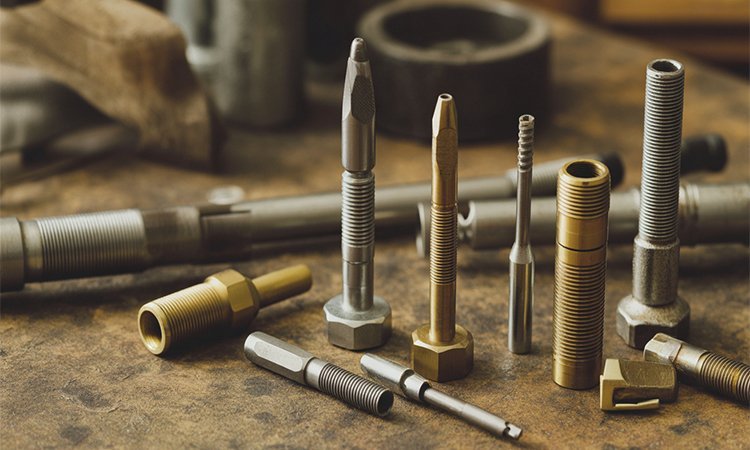
In the world of metal cutting, threading tools hold a place of unique importance. Threads are integral to almost every assembly — from tiny components in electronics to massive machinery in aerospace or automotive sectors. The accuracy, strength, and reliability of these threads depend on the precision of the tools that cut them. Among these, taps and threading tools are the unsung heroes that ensure perfect mating of parts, functional integrity, and long service life of components.
Tapping Process
Tapping is the process of creating internal threads in a pre-drilled hole, and the tool that performs this operation is called a tap. Depending on the application, materials, and type of hole (through or blind), taps come in various designs such as hand taps, spiral point taps, spiral flute taps, and forming taps. Each is engineered to perform optimally under specific cutting conditions. For example, spiral point taps are best for through holes as they push chips ahead, while spiral flute taps are suited for blind holes, efficiently lifting chips out of the cutting zone.
Threading Tools
Modern threading tools, on the other hand, include thread mills and dies, which are equally essential for precision thread generation. Thread milling, a CNC-based process, offers greater flexibility and control over pitch diameter and thread length. It allows the machining of both internal and external threads using the same tool and is particularly advantageous in producing large-diameter or non-standard threads. Unlike tapping, thread milling minimizes the risk of tool breakage and is ideal for difficult-to-machine materials like titanium or Inconel.
The advent of carbide taps and coated threading tools has significantly enhanced productivity and tool life. Coatings such as TiN (Titanium Nitride), TiCN (Titanium Carbonitride), and AlTiN (Aluminum Titanium Nitride) improve wear resistance, reduce friction, and allow higher cutting speeds. Forming taps, which create threads through plastic deformation rather than cutting, eliminate chip formation entirely — a major benefit in automated production environments.
Precision in threading translates directly to dimensional accuracy, surface finish, and mechanical strength of the joint. In industries such as automotive, aerospace, medical devices, and heavy engineering, where components are subject to stress, vibration, and temperature variations, thread integrity is critical. Even minor inaccuracies can lead to leakage, fatigue failure, or assembly mismatch. Hence, the quality of taps and threading tools is inseparable from the quality of the end product.
Innovations in Threading Tools
Continuous innovations in design, materials, and coatings are enabling threading tools to meet evolving industrial demands. High-performance geometries, advanced micro-grain carbide substrates, and coolant-through designs are making tapping faster, cleaner, and more reliable. Manufacturers are also leveraging CNC automation and adaptive feed control to achieve consistent thread quality across large batch production.
In essence, taps and threading tools represent the fine balance between cutting science and craftsmanship. They exemplify how precision at the micro-level defines performance at the macro-level — ensuring that every turn, every thread, fits flawlessly where it matters most.