The Science Behind Chip Control: Why Every Chip Matters in Modern Machining
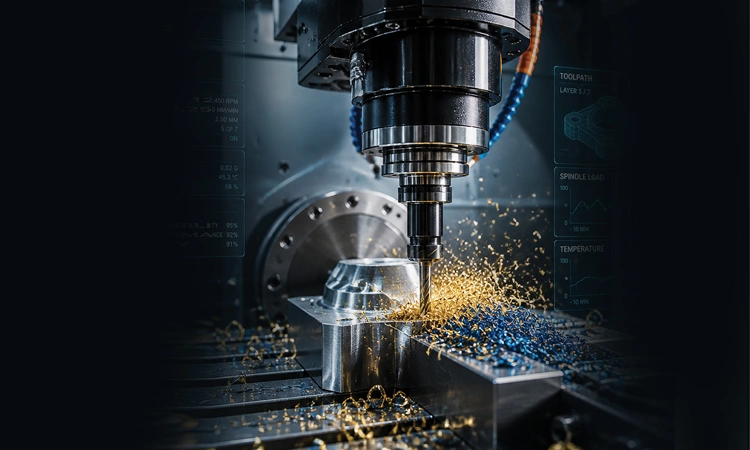
In every machining operation, the focus is often on the finished component-the precision achieved, the surface finish attained, or the cycle time reduced. Yet, one of the most critical indicators of a successful machining process is something that is usually discarded as waste: the chip. Chips are the inevitable by-product of metal cutting, but their shape, size, colour, and flow reveal a great deal about the efficiency and stability of the machining process. Proper chip control is not merely about keeping the machine clean; it is a science that directly influences productivity, tool life, machining accuracy, machine reliability, and operator safety. As manufacturers increasingly adopt high-speed machining, automation, unmanned production, and difficult-to-machine materials, effective chip control has become one of the defining factors of successful metal cutting. Modern cutting tool manufacturers invest considerable research into chip formation, chip breaker design, insert geometry, and coolant technology to ensure that chips are produced, controlled, and evacuated efficiently.
Understanding Chip Formation
Metal cutting is essentially a controlled shearing process. As the cutting tool penetrates the workpiece, material ahead of the cutting edge undergoes intense plastic deformation. Once the stress exceeds the material’s shear strength, the material separates from the workpiece, forming a chip.
This seemingly simple process involves extremely high pressures and temperatures.
During cutting:
- Temperatures at the cutting edge may exceed 800–1,000°C, depending on the material and cutting conditions.
- Enormous compressive forces act on the cutting edge.
- Most of the energy consumed in machining is converted into heat.
- The chip carries away a significant portion of this heat.
Consequently, understanding chip behaviour is essential for achieving stable machining.
Why Chip Control Matters
Poor chip control affects far more than housekeeping.
Long, continuous chips can:
- Damage the machined surface.
- Scratch finished components.
- Wrap around the cutting tool.
- Entangle rotating workpieces.
- Damage toolholders.
- Cause unexpected tool breakage.
- Interrupt automated production.
- Create safety hazards for machine operators.
In contrast, properly controlled chips improve machining stability and ensure uninterrupted production.
Good chip control contributes to:
- Longer tool life
- Better surface finish
- Improved dimensional accuracy
- Higher cutting speeds
- Reliable unattended machining
- Lower machine downtime
- Increased productivity
 Types of Chips
The type of chip produced depends on the workpiece material, cutting parameters, tool geometry, and cooling conditions.
Continuous Chips
These long, ribbon-like chips are common when machining ductile materials such as aluminium and mild steel.
Although they often indicate efficient cutting, excessively long chips can interfere with machining and present safety risks.
Segmented Chips
Frequently produced when machining titanium and high-temperature alloys, segmented chips consist of partially separated sections caused by cyclic deformation during cutting.
They are generally easier to evacuate than continuous chips.
Discontinuous Chips
Short, broken chips are commonly produced when machining brittle materials such as cast iron and certain bronzes.
These chips are generally desirable because they are easy to remove and rarely interfere with machining.
Serrated Chips
Difficult-to-machine materials such as Inconel and hardened steels often produce saw-tooth or serrated chips due to localized shear deformation.
Understanding these chip types allows machinists to optimise cutting conditions for maximum efficiency.
The Role of Chip Breakers
Perhaps the most significant innovation in chip control has been the development of chip breakers.
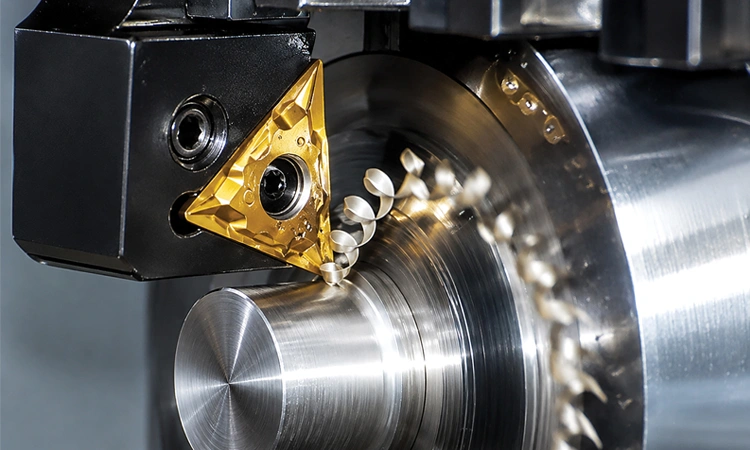
A chip breaker is a specially engineered groove or geometry formed on the insert surface that forces the chip to curl tightly.
As the chip bends, internal stresses develop. Once these stresses exceed the material’s fracture strength, the chip breaks into shorter, manageable segments.
Modern chip breaker designs are highly sophisticated and are optimised for:
- Finishing operations
- Medium machining
- Heavy roughing
- Stainless steels
- Aluminium alloys
- Cast iron
- Heat-resistant superalloys
- Titanium
Rather than offering a universal solution, cutting tool manufacturers now provide application-specific chip breaker geometries tailored to different materials and cutting conditions.
Insert Geometry and Chip Flow
Chip control depends not only on the chip breaker but also on the overall insert geometry.
Important design parameters include:
- Rake angle
- Relief angle
- Nose radius
- Cutting edge preparation
- Edge honing
- Land width
Positive rake inserts generally reduce cutting forces and produce thinner chips, making them suitable for softer materials.
Negative rake inserts provide greater edge strength for heavy-duty machining but require more robust chip control.
The interaction between insert geometry and chip breaker design determines how efficiently chips are formed and evacuated.
Cutting Parameters Influence Chip Formation
Even the best chip breaker cannot compensate for incorrect cutting parameters.
Chip behaviour is strongly influenced by:
Feed Rate
Feed has the greatest effect on chip thickness.
If the feed is too low, the chip may not engage the chip breaker effectively, resulting in long continuous chips.
Increasing the feed often produces better chip breakage.
Depth of Cut
Chip breaker performance is designed for specific depth-of-cut ranges.
Operating outside these limits can significantly reduce chip control effectiveness.
Cutting Speed
Higher cutting speeds often increase chip temperature and ductility.
This may improve or worsen chip breaking depending on the workpiece material.
Finding the optimum balance requires careful process optimisation.
 Coolant: An Important Contributor
Coolant performs several functions in chip control.
High-pressure coolant systems:
- Reduce cutting temperature.
- Lubricate the cutting zone.
- Direct chips away from the cutting edge.
- Break long chips through hydraulic action.
- Prevent chip re-cutting.
Modern CNC machines increasingly employ coolant pressures exceeding 70–150 bar, particularly when machining stainless steels and superalloys.
Internal coolant delivery through the cutting tool further improves chip evacuation in deep-hole drilling and internal turning operations.
Chip Control in High-Speed Machining
High-speed machining introduces additional challenges.
Higher spindle speeds generate:
- Greater chip velocity
- Increased temperatures
- Higher material removal rates
- Greater centrifugal forces
Cutting tools used for high-speed machining therefore incorporate specialised chip breaker designs that maintain effective chip control despite elevated cutting speeds.
Dynamic toolpaths generated by modern CAM software also help maintain consistent chip thickness throughout the machining cycle.
Challenges with Difficult Materials
Modern manufacturing increasingly involves machining materials that resist conventional chip control techniques.
Stainless Steel
Stainless steels tend to produce long, stringy chips due to their toughness and work-hardening characteristics.
Special chip breakers and high-pressure coolant are often essential.
Titanium Alloys
Titanium generates segmented chips and extremely high cutting temperatures.
Tool geometry must balance chip control with heat management.
Nickel-Based Superalloys
Materials such as Inconel produce tough, serrated chips and place enormous stress on cutting tools.
Optimised insert geometry and advanced coatings are critical.
Aluminium Alloys
Although relatively easy to machine, aluminium often produces long continuous chips that require highly polished chip breaker geometries and sharp cutting edges.
Automation Increases the Importance of Chip Control
Modern manufacturing increasingly relies on unattended machining.
Robotic cells, pallet systems, flexible manufacturing systems (FMS), and lights-out production cannot tolerate chip-related interruptions.
Poor chip control can lead to:
- Machine stoppages
- Tool breakage
- Component damage
- Sensor interference
- Automation failures
Consequently, chip control has become a fundamental requirement for automated production.
Digital Technologies and Chip Monitoring
Industry 4.0 is transforming chip management.
Advanced machining centres now employ:
- Machine vision systems
- Acoustic sensors
- Force monitoring
- AI-based process analysis
- Real-time spindle load monitoring
These technologies detect abnormal chip formation and adjust machining parameters before serious problems develop.
Researchers are also exploring intelligent cutting tools with embedded sensors capable of monitoring chip formation directly at the cutting edge.
Sustainability Through Efficient Chip Control
Effective chip control contributes significantly to sustainable manufacturing.
Proper chip management reduces:
- Tool wear
- Machine downtime
- Scrap generation
- Energy consumption
- Coolant usage
- Rework
Broken chips are also easier to collect, recycle, and transport, supporting circular manufacturing initiatives.
The Future of Chip Control
Future developments are expected to include adaptive chip breaker designs, AI-assisted cutting parameter optimisation, digital twins for chip flow simulation, and smart tooling capable of responding dynamically to changing machining conditions.
Additive manufacturing may also enable cutting tools with internal coolant channels and customised chip-control geometries that are impossible to produce using conventional manufacturing methods.
Conclusion
Chip control is one of the most important yet often underestimated aspects of metal cutting. Every chip produced during machining carries valuable information about cutting conditions, tool performance, and process stability. When properly managed, chips enhance productivity, improve surface finish, extend tool life, and enable reliable automated manufacturing.
Advances in insert geometry, chip breaker design, cutting tool materials, coolant delivery, CAM software, and digital monitoring have transformed chip control from a simple workshop concern into a sophisticated engineering discipline. As manufacturers continue to pursue higher speeds, greater automation, and more demanding materials, mastering the science behind chip control will remain essential to achieving precision, efficiency, and competitiveness in modern machining.
Ultimately, the smallest by-product of machining-the chip-often tells the biggest story about the quality and success of the entire manufacturing process.